Modelo 210: Spain's non-resident income tax return, explained
Live abroad and own a place in Spain? Then you file a Modelo 210 for it every year, even if you never let it and it never earns you a cent. Here's how the tax is worked out, when it's due, and what changed for 2026 income.
- Due now: imputed income for 2025, by Thursday 31 December 2026; by direct debit, by 23 December.
- New deadlines: 2026 rent with tax to pay, grouped for the year (or October to December), 1 April to 20 April 2027; imputed income for 2026, from 1 April 2027.
- Rates: 19% if you live in the EU or the EEA, 24% anywhere else; 19% for everyone on a sale.
- One each: every owner files their own, married couples included.
Facts checked on 18 November 2026 against the BOE and the Agencia Tributaria.
What Modelo 210 is and what it's for
Modelo 210 is the return for Spain's non-resident income tax (IRNR), filed by people who don't live in Spain but have income there without a permanent establishment. Owners of a Spanish home use it to declare and pay the tax due on owning it, letting it or selling it, one income and one owner at a time.
A tax for people who live elsewhere
Spanish residents pay income tax (IRPF) on what they earn worldwide. Non-residents pay Spanish tax only on what they earn in Spain, under a separate tax, the non-resident income tax (Impuesto sobre la Renta de no Residentes). Without a permanent establishment in Spain (an office, a business), each income is taxed on its own, and one can't be set against another: that's Modelo 210, approved by Orden EHA/3316/2010.
There's no tax-free allowance and no personal expenses to take off: tax is due from the first euro, however small the amount. How what you pay in Spain counts at home depends on the double tax treaty between your country and Spain, where there is one, and on your country's own law.
What goes on a Modelo 210
The same form covers any income earned in Spain without a permanent establishment: rent, imputed income from urban property, gains on selling property, and also dividends or interest when nobody withheld the tax that was due. This page sticks to homes.
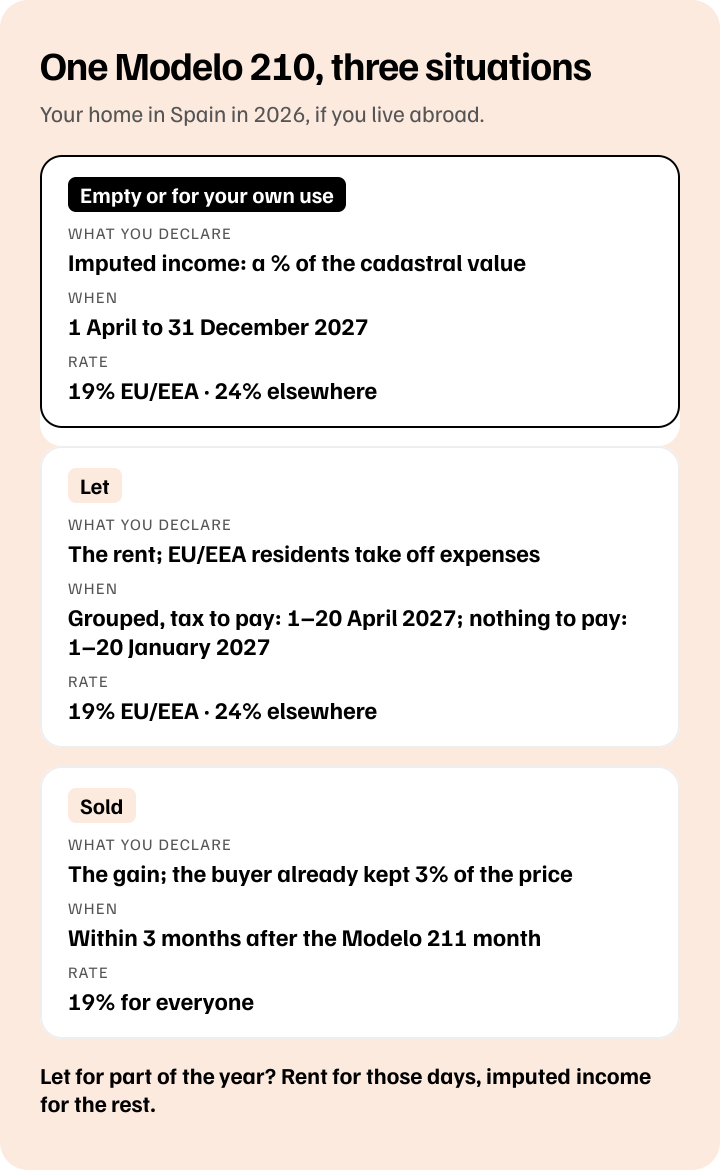
- An empty home, or one you use yourself: imputed income, a percentage of the cadastral value.
- A let home: the rent you received, with or without expenses depending on where you live.
- A sold home: the gain; the buyer has already withheld 3% of the price.
What Orden HAC/623/2026 changes
Orden HAC/623/2026 (BOE, 23 June 2026) changes the deadlines and the form. From 2026 income on, rent with tax to pay, grouped for the year, is filed between 1 April and 20 April of the following year (filed payment by payment, from the accruals of October 2026), and imputed income between 1 April and 31 December. Imputed income for 2025 keeps the old window: the whole of 2026, until 31 December 2026.
Returns filed from 1 January 2027, whatever year the income belongs to, use the new form: it asks for the number of days and your share of ownership, and adds an annex breaking down the rental expenses. Some of the Agencia Tributaria's pages still show the old deadlines (checked 18 November 2026): the order and the Agencia Tributaria's note on it are what count.
Official sources: Non-Residents' Income Tax Act, arts. 5, 13, 15, 24, 28 · Orden EHA/3316/2010 · Orden HAC/623/2026 · Agencia Tributaria: Modelo 210 · Agencia Tributaria: note on Orden HAC/623/2026
Who has to file Modelo 210
You file it if you're not tax resident in Spain and own all or part of a home or other urban property there, even if you never let it. Each owner files separately, for their own share: a married couple files two. It's also for anyone with other Spanish income, no permanent establishment and no withholding that already covers it.
When you count as a non-resident
You're tax resident in Spain if you spend more than 183 days of the calendar year there, if your main centre of business or economic interests is there, or, unless you prove otherwise, if your spouse (not legally separated) and your dependent children under 18 live there (Personal Income Tax Act, art. 9). If none of that applies, you're a non-resident, and your Spanish home goes on a Modelo 210.
If two countries both treat you as resident, their tax treaty decides. The usual proof is a certificate of tax residence from your own country's tax office, valid for a year from when it's issued.
Every owner, every home
Modelo 210 is personal: each owner declares their own share, as the deeds give it, and a home a married couple owns together is split in half, unless another split is proven. A couple owning a house 50/50 files two returns, one each, and never a joint one, except on a sale when both are non-resident (see Selling). CasitaTax's co-owners guide covers life interests and inheritances too.
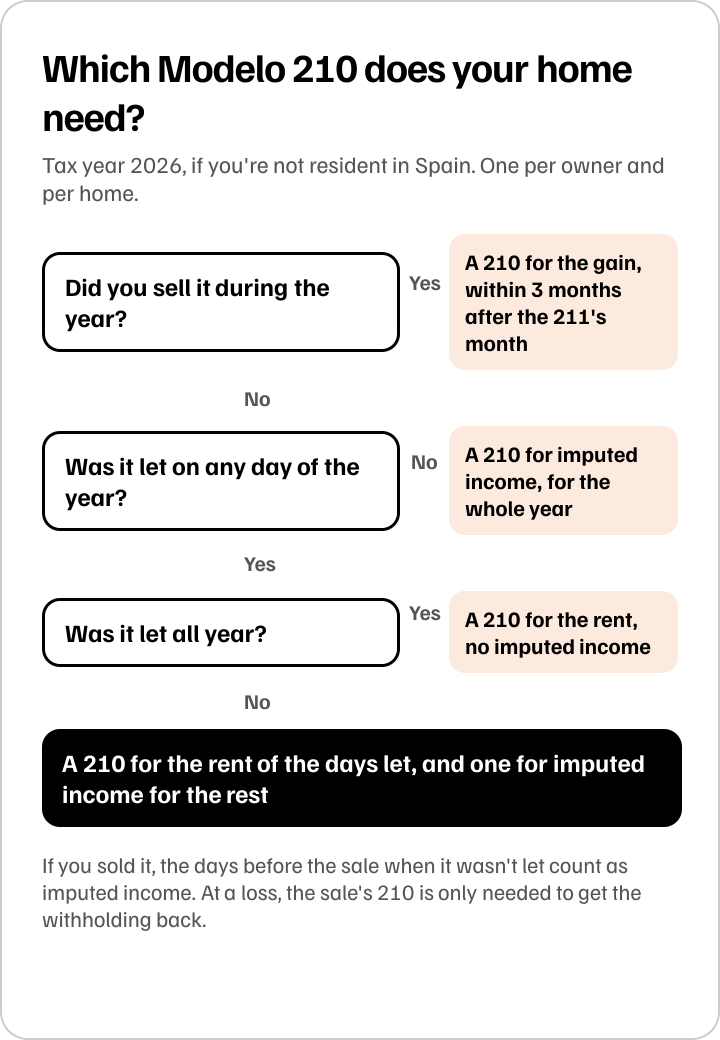
- Empty or used by you all year: one 210 for imputed income.
- Let all year: the 210 for the rent, and no imputed income.
- Let for part of the year: rent for those days, imputed income for the rest, on separate returns.
- Sold: the 210 for the sale, plus imputed income for the days before the sale when it wasn't let.
Who doesn't file one
- Spanish residents: they declare their home, let or not, on the IRPF return (Modelo 100).
- Rent with tax withheld: when the tenant is a company or a professional renting for their business, they withhold the tax on the full rent and pay it in; that rent doesn't go on your 210, unless you're claiming back an excess.
- A building plot, a home under construction, or one that can't be used for planning reasons: none produces imputed income.
- A home in the Basque Country or Navarre: the tax goes to their own (foral) tax offices, with their own forms and deadlines. This page is about the Agencia Tributaria's Modelo 210.
One house, two owners, two 210s?
CasitaTax, our partner, prepares and files one for each of you, every year.
Official sources: Non-Residents' Income Tax Act, arts. 5, 6, 8, 13, 28 · Personal Income Tax Act, arts. 9 and 85 · Orden EHA/3316/2010, arts. 2 and 4 · Basque Economic Agreement (Concierto) · Navarre Economic Agreement (Convenio)
Imputed income: the 210 for a home you don't let
A home you don't let is taxed as if it paid you an income: 2% of its cadastral value, or 1.1% if your town's values were revised in a recent collective valuation, for the days it wasn't let and for your share. You pay 19% or 24% of that, with no expenses taken off.
The formula
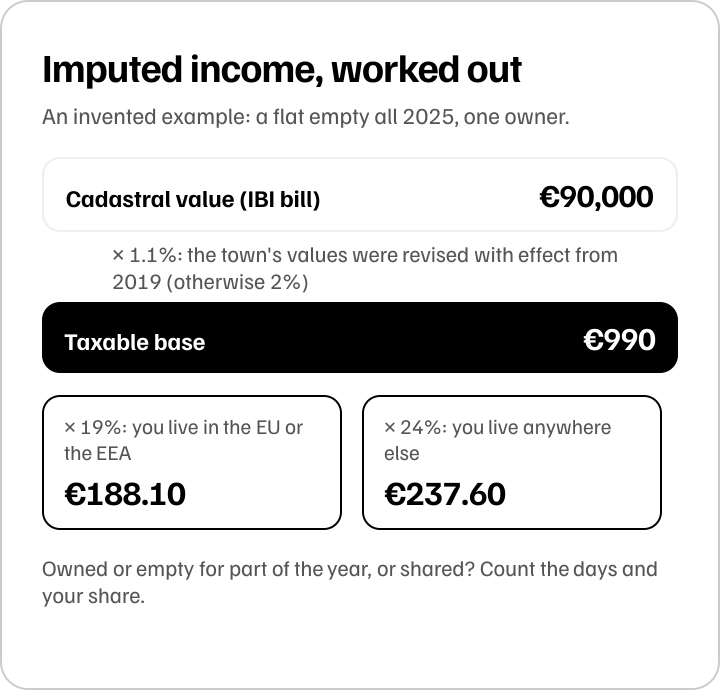
Cadastral value × 2% (or 1.1%) × days not let ÷ days in the year × your share = taxable base. The tax is that base times 19% if you live in another EU country, Iceland, Norway or Liechtenstein, and times 24% anywhere else, the UK included. The income accrues on 31 December each year.
2% or 1.1%?
For 2026: 1.1% if your town's cadastral values were revised, changed or set in a general collective valuation that came into force on or after 1 January 2012 (Personal Income Tax Act, additional provision 55, as worded by Real Decreto-ley 29/2026); otherwise 2%.
For 2025: the general rule of art. 85 gives 1.1% if the revision came into force in 2025 or the 10 years before. The Agencia Tributaria's pages apply the 2012 rule to 2025 too, but the provision that holds it takes effect from 2026, and the BOE doesn't say whether it reaches 2025 (checked 18 November 2026). It only matters if your town's revision came into force between 2012 and 2014.
If the home had no cadastral value on 31 December, or it hadn't been notified, the base is 1.1% of 50% of the higher of two values: the one the authorities checked, or the purchase price.
Where to find the cadastral value
It's on the IBI bill, since it's what the IBI is charged on. As the owner, you can also look it up on the Catastro's online office (Sede Electrónica del Catastro), identifying yourself, with the property's cadastral reference: it's protected data that only the owner and people they authorise can see. Use the total value (land and building), not one of the two. Not sure whether your town's values were revised? CasitaTax's Catastro lookup gives each town's last revaluation year.
What you can't take off, and the days
Nothing comes off imputed income: not the IBI, not community fees, not utilities, not mortgage interest. Expenses only count when the home is let, and only for owners living in the EU or the EEA.
If you bought or sold it during the year, or let it for some days, imputed income only covers the other days. From 1 January 2027, the form asks for that number of days and your share of ownership.
From 2027, a scale
Real Decreto-ley 29/2026 replaces the percentages, from 1 January 2027, with a scale on the sum of the cadastral values: 1.1% up to €100,000, 1.5% up to €500,000, 2% up to €1,000,000 and 3% above. It applies to imputed income for 2027, filed in 2028. How it will apply to non-residents, who file home by home, no text says yet (checked 18 November 2026).
Example: a flat empty all of 2025
A flat with a cadastral value of €90,000, in a town whose values were revised with effect from 2019, one owner, empty all year (invented figures). Base: €90,000 × 1.1% = €990.
An owner living in Germany pays 19%: €188.10. One living in the UK or the US pays 24%: €237.60. If two people own it 50/50, each files a 210 for half. CasitaTax's guide to tax on an empty home goes through more cases.
Imputed income for 2025 is due by 31 December
CasitaTax works it out from the value on your IBI bill and files it for you, no digital certificate needed.
Official sources: Non-Residents' Income Tax Act, arts. 13.1.h, 24.5, 25, 27 · Personal Income Tax Act, art. 85 and DA 55 · Real Decreto-ley 29/2026 · Agencia Tributaria: imputed income · Catastro: FAQ
Rental income: the 210 for a home you let
If you let your home, you declare everything the tenant pays you. Owners living in the EU or the EEA take off the expenses of the days let and pay 19% on the rest; owners living anywhere else, the UK included, pay 24% on every euro received. 2026 rent grouped with tax to pay is filed in April 2027.
What you declare
The base is everything the tenant pays you, for whatever reason, including furniture let with the home or community fees you pass on, without the VAT. None of Spain's income tax reductions for letting a home applies to non-residents. If the tenant is a company or a professional renting for their business, they withhold the tax and that rent stays off your 210; if the tenant is a private person, you declare it.
Living in the EU or the EEA: with expenses
If you live in another EU country, Iceland, Norway or, since 11 July 2021, Liechtenstein, you take off the expenses Spain's income tax allows, for the share that matches the days let, as long as they're directly linked to the letting. A certificate of tax residence from your country backs it up.
- Interest on the loan used to buy or improve the home.
- IBI, the rubbish charge, community fees and insurance.
- Repairs and upkeep, utilities you pay, management and contract costs.
- Depreciation of the home (not the land) and of the furniture.
- Interest and repairs can't exceed the rent from that home: the excess carries forward over the next four years.
Living outside the EU and the EEA: on the full rent
If you live in the UK, the US, Switzerland or anywhere else outside the EU and the EEA, you pay 24% of all the rent you receive, with no expenses taken off. For the UK, that has been so since 2021 income.
Holiday lets
If all you do is make the home available to guests, even by the night, it's a letting like any other: you declare it on the 210 stay by stay, or grouped. If you also provide hotel-type services (a restaurant, cleaning, laundry…) or employ someone full time, the Agencia Tributaria treats it as a business carried on through a permanent establishment, which no longer goes on the 210.
The days the home wasn't let produce imputed income, empty days between two stays included: for the Agencia Tributaria, a home waiting for a tenant produces imputed income and its expenses can't be deducted (its 2025 IRPF manual, citing the Supreme Court's judgment of 25 February 2021). That is the IRPF rule, the same one the non-resident tax applies; its non-resident pages don't address it separately. From 1 December 2026 many holiday lets also pay VAT (see "Other taxes"). To keep count of nights and expenses, CasitaTax has a free rental log.
Payment by payment, or the year grouped: the 2026 deadlines
You can file one 210 for each accrual (each time rent falls due) or group a whole year for the same home into one (under code 35 when there are several tenants who don't withhold, as with a holiday let). Under Orden HAC/623/2026, 2026 rent grouped for the year, and rent accrued from 1 October 2026 filed separately, is due between 1 April and 20 April 2027 (by direct debit, by 15 April). Separate returns for January to September 2026 had their own deadlines in April, July and October 2026.
If the expenses bring the tax down to zero, the return goes in between 1 January and 20 January 2027.
Example: a flat let all year
A flat let all year for €9,600, with €2,600 of deductible expenses (invented figures). An owner living in France declares €7,000 and pays 19%: €1,330. An owner living in the UK pays 24% of the full €9,600: €2,304. 19% or 24% in your case? CasitaTax's rate guide goes country by country.
Letting your home?
CasitaTax declares your rent on time, with the expenses you can deduct if you live in the EU.
Official sources: Non-Residents' Income Tax Act, arts. 13.1.g, 24, 25 · Orden HAC/623/2026 · Agencia Tributaria: rental income · Agencia Tributaria: tourist lets · Agencia Tributaria: Brexit
Selling: Modelo 211, the 3% and the 210 for the gain
When a non-resident sells property in Spain, the buyer keeps back 3% of the price and pays it in with Modelo 211 within a month. The seller then files their own 210 within the following 3 months: 19% of the gain, less what was withheld, or a claim for the difference back.
The 3% the buyer keeps back
The buyer, resident or not, must hold back 3% of the agreed price, pay it in with Modelo 211 within a month of the sale, and give you a copy of the 211. That money isn't your tax: it's a payment on account, which you take off on your 210. If the buyer doesn't pay it in, the home itself stands as security for the lower of the withholding and the tax.
How the gain is worked out
Gain = (sale price − costs and taxes of selling) − (purchase price + costs and taxes of buying + improvements). The gain is taxed at 19%, wherever you live, and since 2015 without inflation coefficients. If you inherited the home or were given it, its purchase value is the one that comes out of inheritance or gift tax, capped at market value, plus costs.
If it was let, the purchase value may have to come down by the depreciation of those years: the Agencia Tributaria's pages don't agree on owners who couldn't deduct it, such as residents outside the EU and the EEA (checked 18 November 2026).
A loss, or too much withheld
The 3% withheld comes off the tax. If it's more than the tax, the 210 claims a refund. If you sold at a loss, you don't have to file, except to get the withholding back, which is usually why you'd file. A married couple, both non-resident, selling a home they own together may file a single 210 for the sale.
If you live in the EU or the EEA and sell what was your main home in Spain, the gain can be exempt if you reinvest the proceeds in a new main home.
Deadline: the following three months
The 210 for a sale is due within the 3 months that follow the buyer's month to pay in the withholding, whatever the result: in practice, between the second and the fourth month after signing. It can't be paid by direct debit. CasitaTax's selling page works out the gain and the withholding for your sale.
Example: a sale at a gain
A flat bought for €180,000, with €14,000 of buying costs and taxes, sold for €240,000, with €6,000 of selling costs (invented figures, no depreciation). Gain: €40,000. Tax at 19%: €7,600. The buyer already withheld €7,200, so €400 is left to pay with the 210.
Selling? Get back what's left of the 3%
CasitaTax files the 210 for the sale and claims the refund when there is one.
Official sources: Non-Residents' Income Tax Act, arts. 13.1.i, 24.4, 25 · Orden EHA/3316/2010 · Agencia Tributaria: selling property · Agencia Tributaria: Modelo 211
Modelo 210 deadlines in 2026 and 2027
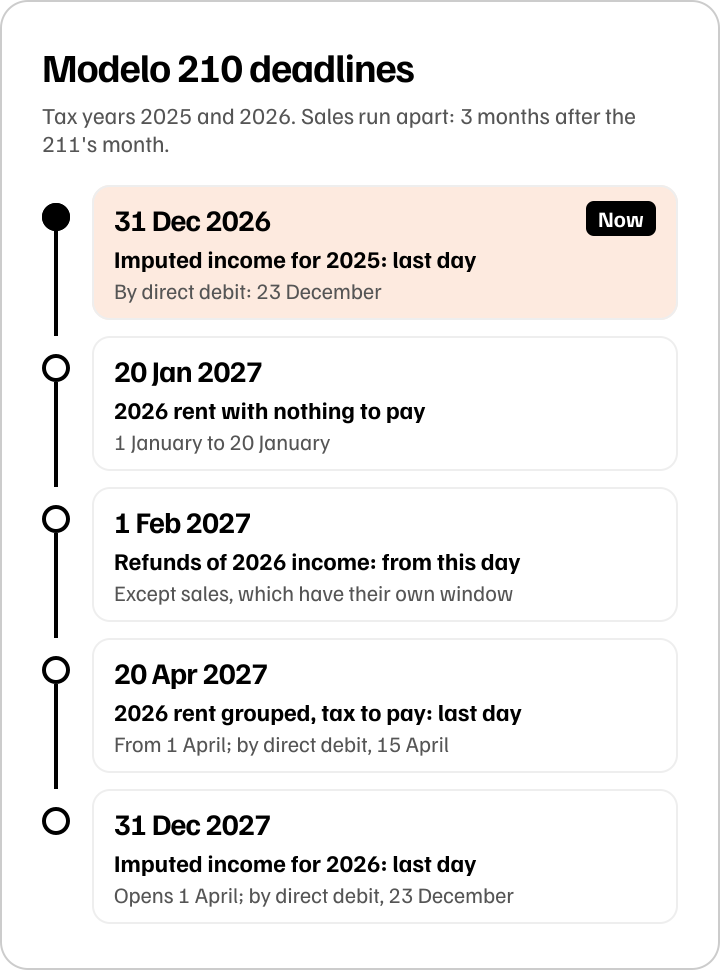
Imputed income for 2025 is due by 31 December 2026. Then: 2026 rent with nothing to pay, 1 January to 20 January 2027; with tax to pay and grouped, 1 April to 20 April (Orden HAC/623/2026); imputed income for 2026, 1 April to 31 December 2027. Sales run on their own clock.
| Income | Window | Direct debit |
|---|---|---|
| Imputed income, 2025 | 1 January to 31 December 2026 | By 23 December 2026 |
| Rent, 2026, nothing to pay | 1 January to 20 January 2027 | Nothing to pay |
| Rent, 2026, tax to pay, grouped or October to December | 1 April to 20 April 2027 | 1 to 15 April 2027 |
| Imputed income, 2026 | 1 April to 31 December 2027 | By 23 December 2027 |
| Sale of a property | 3 months from the end of the Modelo 211 month | Not possible |
| Refund claims (2026 income, except sales) | From 1 February 2027; 4 years from the end of the withholding's period | — |
Due now: imputed income for 2025
Imputed income for 2025 is the last one filed at any time in the following year: by Thursday 31 December 2026. To pay by direct debit, file by 23 December 2026. After the 31st, it's a late return, with a surcharge. The window for 2026 opens on 1 April 2027; no text says whether an earlier return is accepted.
When the last day is a weekend or a holiday
A deadline that ends on a non-working day moves to the next working day (Ley 39/2015, art. 30.5). None of the deadlines on this page falls on one: 31 December 2026 is a Thursday, 20 January 2027 a Wednesday, 20 April 2027 a Tuesday and 31 December 2027 a Friday. The Agencia Tributaria hasn't published its 2027 calendar yet (checked 18 November 2026): these dates come from the order.
To keep them in sight, CasitaTax has a Modelo 210 calendar that goes into Google, Apple or Outlook.
Earlier years you didn't file
If you missed earlier years, you can still file them now: the tax office can claim each return for 4 years from the end of its window. Filing before it asks costs a surcharge, not a penalty, or €100 if there was nothing to pay (see surcharges).
Until 31 December for imputed income for 2025
Leave your details in good time and CasitaTax files it before the deadline.
Official sources: Orden EHA/3316/2010, arts. 5 and 13 · Orden HAC/623/2026 · Orden EHA/1658/2009, annex II · Agencia Tributaria: 210 deadlines · Ley 39/2015, art. 30
How to file Modelo 210, step by step
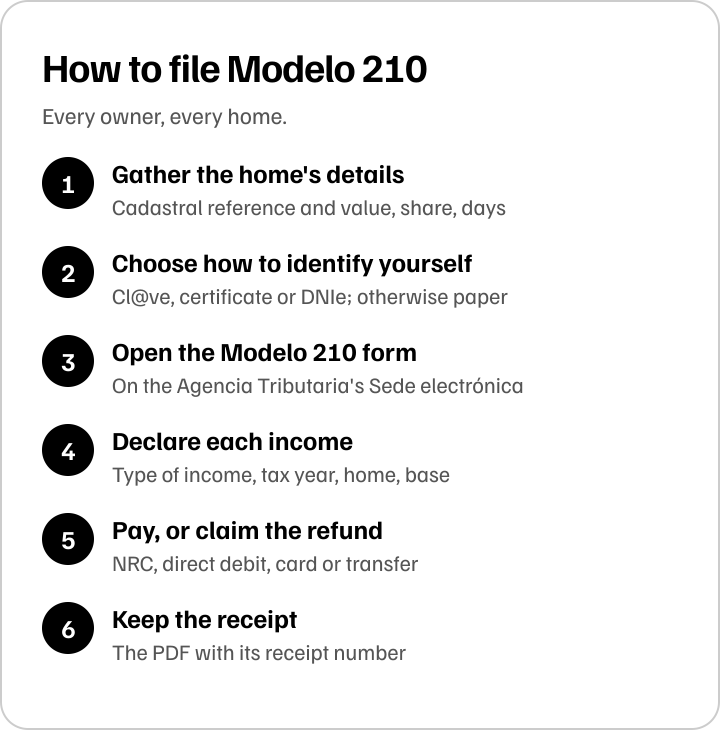
You fill in the 210 on the Agencia Tributaria's online form. With Cl@ve, a digital certificate or a DNIe you file and pay online; without them, you print it as a pre-declaration and pay at a Spanish bank or by transfer from abroad. With no NIE, the paper form itself gives you an identification code.
The steps, start to finish
- 1
Gather the home's details
The cadastral reference (it's on the IBI bill), the cadastral value, your share of ownership, the days it was let and, if you let it, the rent and the expenses with their invoices.
- 2
Choose how to identify yourself
Filing online needs a Spanish tax number (an NIE will do) plus Cl@ve, a digital certificate or a DNIe. Without them, you fill in the same form and print it as a pre-declaration.
- 3
Open the Modelo 210 form
Go to the Modelo 210 page of the Sede electrónica. If you have no NIE, a button in the pre-declaration gives you an identification code: keep it for the years ahead.
- 4
Declare each income
Give the type of income (02 imputed income, 01 rent, 28 a sale), the tax year, the home and its base. The rate, 19% or 24%, depends on your country of residence. One return per owner, per home and per type of income.
- 5
Pay, or claim the refund
With tax to pay: an NRC from a collaborating bank, a card on the Agencia Tributaria's payment page, direct debit (from a SEPA-zone account too, except for a sale) or a transfer from abroad. For a refund, you give your account, in Spain or elsewhere.
- 6
Keep the receipt
Keep the PDF of the filed return, with its receipt number and secure verification code. You'll need it to show at home what you paid in Spain, and for any letter from the tax office.
Without a certificate: the paper pre-declaration
You fill in the form on the Sede, click «Generar predeclaración» and print the PDF; you write your NIF (or the code you were given) on every copy of the payment or refund document and sign it by hand.
- Tax to pay, from Spain: you hand it in and pay at a collaborating bank.
- Tax to pay, from abroad: you pick «A ingresar mediante transferencia bancaria desde el extranjero» and send a transfer in euros, from a bank that isn't a collaborating one, with the payment identifier as its reference; it lapses after 30 days. You don't post the paper: the return counts as filed once the money arrives. Any documents you must provide, such as the residence certificate, go by post to the Oficina Nacional de Gestión Tributaria in Madrid.
- A refund or nothing to pay: you hand it in, or send it by registered post, to the Agencia Tributaria's office for the province where the home is; if you used the code you were given and name no representative and no Spanish address, to the Oficina Nacional de Gestión Tributaria in Madrid.
Paying without a Spanish bank account
Since 1 February 2024, direct debit also works from an account at a bank in the SEPA zone (the EU, the UK, Switzerland, Norway, Iceland, Liechtenstein, Andorra, Monaco, San Marino and the Vatican), when you file online within the direct-debit window. Online, you can also pay by transfer from abroad with the payment identifier. Refunds go to your own account, in Spain or abroad. CasitaTax's guide to paying from abroad takes you through it.
Having someone else file it
An agency registered as a social collaborator (colaborador social) of the Agencia Tributaria, or someone you've given a power of attorney, can file it for you with their own certificate. But for imputed income, rent and a sale, the owner stays the declarant: nobody can file it in their own name. A refund goes to your own account, in Spain or abroad; to a representative's only if they're your legal representative.
Do you need a fiscal representative?
If you live in the EU, or in an EEA State with mutual assistance on tax information and debt recovery, no. If you live anywhere else, only in specific cases: when the Agencia Tributaria requires one because of the amount of your income or because you own property in Spain, when you carry on a business there, or when you live in a non-cooperative jurisdiction. Not appointing one when it's required costs a €2,000 fine, or €6,000 for a non-cooperative jurisdiction (Non-Residents' Income Tax Act, art. 10). Otherwise it's up to you.
Rather not do it yourself?
CasitaTax, our partner, prepares each owner's Modelo 210, files it once you approve the figures, pays the tax on your behalf and sends you the filed return and the receipt.
Get my 210 filed- No digital certificate or Spanish bank account needed.
- Imputed income, rent, sales and missed years.
- One 210 per owner and per home, on time.
Official sources: Orden EHA/3316/2010, arts. 2, 3, 10–14 · Orden EHA/1658/2009 · Agencia Tributaria: filing and paying · Agencia Tributaria: Modelo 210 · Non-Residents' Income Tax Act, art. 10
Filing late: Modelo 210 surcharges and penalties
File late before the tax office asks and you pay a surcharge: 1% plus 1% for each full month late, and 15% plus interest after a year. If they ask first, the penalty is 50% to 150% of the unpaid tax. A late return with nothing to pay: €100, or €200 if they asked first.
Before they ask: a surcharge
A return with tax to pay that's filed late, before any request from the tax office, gets a surcharge, not a penalty: 1% plus 1% for each full month late; after twelve months, 15% plus late-payment interest (General Tax Act, art. 27.2). The surcharge is cut by 25% if you pay the full tax when you file and the surcharge within the period its notice gives (art. 27.5).
CasitaTax's missed-years calculator estimates the tax, surcharge and interest year by year.
After a request: a penalty
If the tax office finds the unpaid tax first, the penalty is 50% of it in minor cases and can reach 150% in very serious ones (art. 191), plus interest. It's cut by 40% if you pay on time and don't appeal (art. 188.3).
A return with nothing to pay (zero or a refund) filed late carries a fine of €200, or €100 if you file before they ask (art. 198).
Missed years, or a letter from the tax office?
Tell us about it in the form and CasitaTax will get in touch.
Official sources: General Tax Act, arts. 27, 66, 188, 191, 198
Modelo 210: frequently asked questions
The most common questions, with the short answer.
Do I have to file a 210 if my house stands empty?
Yes. A home you don't let produces imputed income: a percentage of its cadastral value, taxed at 19% or 24% depending on where you live. The one for 2025 is due by 31 December 2026.
We own it together: do we both have to file?
Yes. Each owner files their own 210 for their share: there's no joint return, married couples included. The one exception is a married couple, both non-resident, selling a home they own together.
I live in the UK: is it 19% or 24%?
24%, with no expenses taken off, since 2021 income: the UK is no longer in the EU or the EEA. On a sale, the gain is taxed at 19%, as for everyone.
Do I need an NIE to file a 210?
To file online, yes: a Spanish tax number (an NIE will do) with Cl@ve, a certificate or a DNIe. On the paper pre-declaration, if you have no tax number, the form itself gives you an identification code to keep for the years ahead.
Can I pay from a bank account abroad?
Yes: by transfer from abroad, with the payment identifier the Agencia Tributaria gives you, even without a certificate; or, when you file online and within the direct-debit window, by direct debit from a SEPA-zone account, the UK and Switzerland included (not for a sale). Refunds can go to an account abroad too.
I didn't file in earlier years. What now?
File them as soon as you can, before the tax office asks: you'll pay a surcharge (1% plus 1% a month, 15% after a year), not a penalty. The tax office can claim the last 4 years.
What expenses can I deduct from my rent?
Only if you live in the EU or the EEA, with a certificate of tax residence: loan interest, IBI, community fees, insurance, repairs, utilities you pay, management and depreciation, for the share of days let. Living anywhere else, nothing comes off.
How do I get the 3% back after selling?
With the 210 for the sale: if the tax on the gain is less than what was withheld, or you sold at a loss, the return claims a refund. It's due within the 3 months that follow the buyer's month to pay in the Modelo 211.
Do I need a fiscal representative in Spain?
If you live in the EU (or an EEA State with mutual assistance), no. If you live anywhere else, only if the Agencia Tributaria requires one, if you carry on a business in Spain, or if you live in a non-cooperative jurisdiction. Having someone file your 210 for you is a different matter.
Can I file imputed income for 2026 now?
No: its window opens on 1 April 2027 and closes on 31 December 2027. No text says whether a return filed earlier is accepted. What's due now is 2025's, by 31 December 2026.
Modelo 210 glossary
- IRNR
- Impuesto sobre la Renta de no Residentes: the income tax non-residents pay in Spain on what they earn there.
- Non-resident
- Someone who spends no more than 183 days a year in Spain and doesn't have their economic interests or family there.
- Imputed income
- The income the law attributes to a home that isn't let: a percentage of its cadastral value.
- Cadastral value
- The value Spain's cadastre (the Catastro) gives a property; the IBI is charged on it, and it's on the IBI bill.
- Collective valuation
- A revision of every cadastral value in a town; its date decides between 1.1% and 2%.
- Cadastral reference
- The twenty-character code that identifies a property in the Catastro.
- NIE
- Número de identidad de extranjero: a foreigner's Spanish tax number.
- EEA
- The European Economic Area: the EU countries plus Iceland, Norway and Liechtenstein.
- Accrual (devengo)
- When the tax becomes due: for imputed income, 31 December each year.
- Pre-declaration (predeclaración)
- The Modelo 210 filled in on the Sede and printed, to file without a digital certificate.
- Modelo 211
- The return the buyer uses to pay in the 3% withheld from a non-resident seller.
- NRC
- Número de referencia completo: the payment reference a bank gives you, which lets you file the return.
- Request (requerimiento)
- A letter from the tax office asking you to file or explain; filing before it arrives makes lateness cheaper.
Let CasitaTax do it
Get my 210 filedWant CasitaTax to file it for you?
Leave your details and CasitaTax, our partner, will get in touch to prepare and file your Modelo 210 on your behalf.
CasitaTax prepares the Modelo 210 for non-residents who own a home in Spain, one per owner, files it once they approve the figures, pays the tax on their behalf and sends them the filed return and the receipt.
See CasitaTax's serviceBasic information on data protection
- Controller:
- ONBOARDING, S.L.
- Purpose:
- passing your request to CasitaTax so that it contacts you about it.
- Legal basis:
- your consent (GDPR art. 6.1.a), which you can withdraw at any time.
- Recipients:
- CasitaTax (ZAHARD LTD, United Kingdom, a country with a European Commission adequacy decision); as processors, Cloudflare, n8n and Discord (Cloudflare and Discord in the US, under the EU-U.S. Data Privacy Framework).
- Rights:
- access, rectification, erasure, objection, restriction and portability, at contacto@modelo-210.net; and a complaint to the Spanish data protection authority (AEPD).
- More information:
- in the privacy policy.